Environment
This page brings together the core principles of the Latvenergo Group environmental and energy management policy, climate targets, impact assessments and indicators that characterise the Group’s responsible and sustainable operations.
Environmental and energy management policy principles
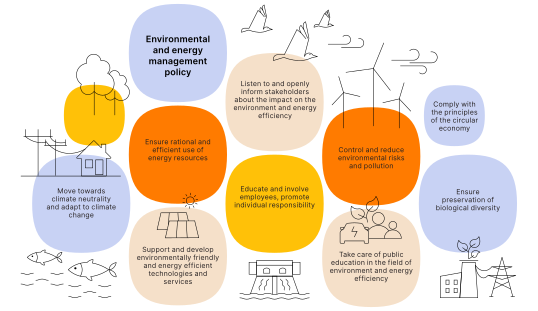
The Latvenergo Group’s environmental protection activities are based on the Sustainability Policy and the Environmental and Energy Management Policy, ensuring sustainable operations in line with national and international standards. Their goal is to continuously improve environmental performance, reduce the impact on the environment and climate, move towards climate neutrality, preserve biodiversity and promote a responsible attitude among employees towards the environment and energy resources.
 Environmental and energy management policy
In its operations and development, the Group takes into account the UN Sustainable Development Goals and European Green Deal trends, complies with external and internal legislation on energy management, environmental and nature protection, and identifies and observes the needs of customers, affected communities and other stakeholders.
Latvenergo Group’s ability to continuously improve its environmental performance is confirmed by a certified ISO 14001-compliant environmental management system and an ISO 50001-compliant energy management system.

Climate
The Latvenergo Group is committed to achieving climate neutrality by 2050, supporting the goals of the Paris Agreement. The transition strategy is based on decarbonisation, the development of renewable energy resources and improved energy efficiency, setting two main climate targets:
- In the medium term, by 2030, to reduce direct greenhouse gas (GHG) emissions by 47% (compared to 2021) while increasing the share of renewable energy resources (RES) in electricity generation to 80%
- in the long term, an ambitious goal of achieving climate neutrality in electricity generation by 2040; to attain it, active research is taking place in the area of CHPP decarbonisation solutions, with assessments of other technological options to reduce emissions
The GHG emissions reduction target indicators were developed with consideration of the EU Green Deal goals and the 2021–2030 Latvian National Energy and Climate Plan into account. The target indicators were set based on the International Energy Agency’s (IEA) Net Zero Emissions by 2050 scenario and the energy sector decarbonisation roadmap.
The Latvenergo Group’s GHG emissions are assessed in accordance with ISO 14064-1 and the GHG reporting standard developed by the World Resources Institute, the GHG Protocol (GHG Protocol Corporate Accounting and Reporting Standard).
Direct (Scope 1) GHG emissions and their intensity
Indirect (Scope 2) GHG emissions
Indirect (Scope 3) GHG emissions
Swipe to see more data
| Indicator | Unit | Base year* | 2024 | 2025 | Δ 2024 | Δ base year |
|---|---|---|---|---|---|---|
| Scope 1 GHG emissions | thousand t CO₂e | 940 | 799 | 780 | -2% | -17% |
| From combustion plants | thousand t CO₂e | 778 | 759 | |||
| From fuel used for transport and machinery | thousand t CO₂e | 8 | 7 | |||
| Leaks of fluorinated GHGs | thousand t CO₂e | 0,4 | 0,2 | |||
| From hydropower plant reservoirs | thousand t CO₂e | 13,0 | 13,0 | |||
| Share of Scope 1 GHG emissions covered by regulated emissions trading systems | % | 96 | 96 | |||
| Scope 2 GHG emissions (location-based) | thousand t CO₂e | 43 | 36 | 45 | 24% | 4% |
| From generation of purchased electricity | thousand t CO₂e | 9 | 10 | |||
| From purchased heat generation | thousand t CO₂e | 0,5 | 0,5 | |||
| From electricity distribution losses | thousand t CO₂e | 27 | 34 | |||
| Scope 2 GHG emissions (market-based) | thousand t CO₂e | 121 | 114 | 109 | -4% | -9% |
| From generation of purchased electricity | thousand t CO₂e | 8 | 7 | |||
| From purchased heat generation | thousand t CO₂e | 0,5 | 0,5 | |||
| From electricity distribution losses | thousand t CO₂e | 106 | 101 | |||
| Material Scope 3 GHG emissions | thousand t CO₂e | 2 752 | 3 413 | 3 392 | -1% | 23% |
| (1) Purchased goods and services | thousand t CO₂e | 123 | 263 | |||
| (2) Capital goods | thousand t CO₂e | 16 | 21 | |||
| (3) Fuel- and energy-related activities | thousand t CO₂e | 3 034 | 2 790 | |||
| (5) Waste generated | thousand t CO₂e | 0,5 | 1,7 | |||
| (6) Business travel | thousand t CO₂e | 0,2 | 0,1 | |||
| (7) Employee commuting | thousand t CO₂e | 3,3 | 3,2 | |||
| (11) Use of sold products | thousand t CO₂e | 236 | 313 | |||
| (4, 8, 9, 12, 13) Other Scope 3 GHG emissions | thousand t CO₂e | 0,1 | 0,1 | |||
| Total GHG emissions (location-based) | thousand t CO₂e | 3 735 | 4 249 | 4 217 | -1% | 13% |
| Total GHG emissions (market-based) | thousand t CO₂e | 3 812 | 4 327 | 4 281 | -1% | 12% |
| GHG emissions outside Scopes 1–3 | thousand t CO₂e | 97 | 97 | 0% | ||
| Direct biogenic emissions | thousand t CO₂e | 97 | 97 | |||
| GHG emission intensity, net revenue ** | t/thousand EUR | 2,493 | 2,692 | 8% | ||
| GHG emission intensity, net revenue *** | t/thousand EUR | 2,539 | 2,733 | 8% |
*Compared to Scope 1 emissions in 2021
**Location-based
***Market-based
By committing to climate neutrality, Latvenergo will contribute to global efforts to reduce emissions and mitigate the impacts of climate change. Moving towards climate neutrality is an important factor in the company’s sustainable development path, contributing not only to environmental protection and risk reduction but also to its reputation and long-term development.
 -47%CO2
Reduce direct CO2 emissions by 2030*
Performance indicator: <500 000 t per year
 80%
Increase the share of electricity generated from renewable sources by 2030
Performance indicator: 80% electricity generated from RES
 -20%CO2
Reduce indirect (Scope 3) CO2 emissions from electricity trade**
Performance indicator: 20% less CO2 in 2030
 0.06tCO2/MWh
Achieve climate neutrality in electricity generation by 2040
Performance indicator: 0.06 t CO2/MWh generated electricity in 2030
*compared to 2021
**compared to 2022
2025 performance:
- Scope 1 GHG emissions: -17% compared to 2021
- GHG emissions from electricity retail: +8% compared to 2022
- Share of green energy sold at retail: 12%
- The share of RES in energy generation: 66%
Latvenergo Group promotes efficient use of energy resources by recording and analysing the flow of energy consumption, identifying essential energy consumption for ensuring production and economic processes and implementing measures to reduce energy consumption.
The Group has a balanced and environmentally friendly generation portfolio, consisting mainly of hydropower plants and highly efficient thermal power plants. In 2025, 53% of energy was generated from RES.
Latvenergo Group's direct energy consumption covers all forms of energy use, including those that contribute to Scope 1 GHG emissions. This includes all fuels used in the Group’s CHPPs and boiler houses, as well as other energy sources: petrol and diesel fuel. Indirect energy consumption consists of the Group’s heat and electricity consumption.
Energy generated
Swipe to see more data
| Indicator | Unit | 2024 | 2025 | Δ 2024 |
|---|---|---|---|---|
| Energy produced from renewable energy sources | % | 53 | 53 | 1% |
| Water | % | 48 | 46 | |
| Wind | % | <0,1 | 1 | |
| Solar | % | 1 | 3 | |
| Wood | % | 4 | 4 | |
| Energy produced from fossil energy sources | % | 48 | 47 | -1% |
| Natural gas | % | 48 | 47 | |
| Diesel fuel (including small amounts of coal and LPG) | % | <0,1 | <0,1 | |
| Electricity generated | GWh | 4 842 | 4 698 | -3% |
| From renewable resources | % | 66 | 66 | 0% |
| From non-renewable resources | % | 34 | 34 | 0% |
| Heating energy produced | GWh | 1 671 | 1 560 | -7% |
| From renewable resources | % | 13 | 14 | 2% |
| From non-renewable resources | % | 87 | 86 | -2% |
Energy consumption and energy source structure
Swipe to see more data
| Indicator | Unit | 2024 | 2025 | Δ 2024 |
|---|---|---|---|---|
| Total energy consumption, fossil energy sources | MWh | 4 077 570 | 3 987 161 | -2% |
| Fuel consumption from natural gas | MWh | 3 859 343 | 3 766 830 | |
| Fuel consumption from petroleum products | MWh | 143 | 139 | |
| Fuel consumption from coal and coal products | MWh | 0 | 21 | |
| Consumption of petroleum-based fuel for transport and machinery | MWh | 28 424 | 27 574 | |
| incl. diesel consumption | MWh | 24 963 | 23 864 | |
| incl. petrol consumption | MWh | 3 462 | 3 710 | |
| Consumption of purchased electricity from fossil energy resources | MWh | 186 062 | 188 981 | |
| Consumption of purchased fossil fuel thermal energy | MWh | 3 598 | 3 616 | |
| Consumption from nuclear resources* | MWh | 23 314 | 38 711 | 66% |
| Total energy consumption, renewable energy sources | MWh | 364 160 | 353 960 | -3% |
| Fuel consumption from renewable energy sources | MWh | 270 720 | 270 911 | |
| Consumption of purchased electricity from renewable energy resources | MWh | 89 579 | 78 898 | |
| Consumption of purchased heat from renewable energy resources | MWh | 3 860 | 4 151 | |
| Total energy consumption | MWh | 4 465 044 | 4 379 832 | -2% |
| Share of fossil energy resources in total energy consumption | % | 91 | 91 | |
| Share of nuclear energy in total energy consumption | % | 0,50 | 0,90 | |
| Share of renewable energy resources in total energy consumption | % | 8,20 | 8,10 | |
| Energy intensity** | MWh/EUR | 0,0026 | 0,0028 | 7% |
*Consumption consists of the share of nuclear energy in the uncertified electricity volume.
**Total energy consumption per net revenue.
Environmental information
Air pollutant emissions of the Latvenergo Group are directly affected by the type of fuel used, the amount of energy generated and the efficiency of technologies. The Group’s plants use three main types of fuel, each with its own characteristic emission profile. The Group’s air emissions mainly come from large combustion plants. Natural gas used at the CHPP plants and Liepāja plants of Latvenergo AS produces NOx and CO emissions. Diesel fuel, which the CHPP plants use as emergency fuel, in addition to NOx and CO also produces SO2, particulate matter and hydrocarbon emissions during its storage. Wood used at the Liepāja plants, in turn, produces NOx, CO and particulate matter emissions.
NOx, CO, SO2 and other emissions
Swipe to see more data
| Indicator | Unit | Target for 2030 | 2021 | 2022 | 2023 | 2024 | 2025 |
|---|---|---|---|---|---|---|---|
| NOx | t | 686 | 374 | 534 | 512 | 448 | |
| NOx from combustion plants | kg/MWh | 0,15 | 0,13 | 0,17 | 0,15 | 0,14 | |
| NOx total for the Group | kg/MWh | 0,03 | 0,10 | 0,07 | 0,08 | 0,08 | 0,07 |
| CO | t | 363 | 231 | 358 | 333 | 269 | |
| CO from combustion plants | kg/MWh | 0,08 | 0,08 | 0,12 | 0,10 | 0,08 | |
| CO total for the Group | kg/MWh | 0,02 | 0,05 | 0,04 | 0,05 | 0,05 | 0,04 |
| SO2 | t | 5 | 25 | 14 | 6 | 6 | |
| Particulate matter | t | 13 | 17 | 17 | 21 | 15 | |
| Other* | t | 6 | 6 | 6 | 4 | 6 |
*includes the amount of volatile organic compounds and other hydrocarbons
The amount of emissions per unit of energy generated, or specific emissions, reflects the efficiency of the Group’s existing processes and the technical solutions implemented to reduce pollutant emissions. Latvenergo continues to promote the development of generation capacity based on renewable energy resources (wind and solar energy), improve energy generation efficiency and maximise the use of renewable energy resources.
Latvenergo Group commitment to reduce pollution

-50%
NOx
CO
Reduce air emissions by 2030
Performance indicator: -50% NOx and CO per unit of energy generated (compared to 2022)
 0significant cases
Strive for zero environmental pollution
Performance indicator: 0 significant incidents annually
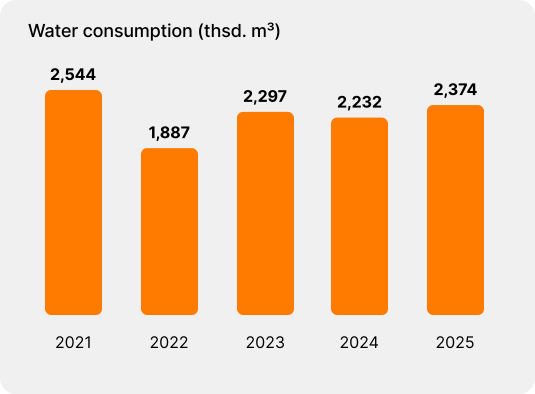
The Group uses water resources mainly to support production processes, and in small amounts for other business needs and for supplying water to external consumers. According to the World Resources Institute Aqueduct Water Risk Atlas, Latvia is in a low to low-to-medium water stress zone, so there are no specific water consumption restrictions. The volume of surface and/or groundwater consumption is set in the permits of each site. The Group’s water consumption balance includes surface water, groundwater and mains water.
By developing RES generation and implementing water-saving measures to the extent technically feasible, Latvenergo will significantly reduce water consumption per unit of energy generated.
Latvenergo’s Daugava HPPs reservoirs are classified as heavily modified water bodies with limited possibilities to improve their quality; however, Latvenergo is implementing biodiversity conservation activities which have an impact on the quality of water bodies and are included in the management plan of Daugava River Basin.
Water resource consumption
Swipe to see more data
| Indicator | Unit | 2021 | 2022 | 2023 | 2024 | 2025 |
|---|---|---|---|---|---|---|
| Water abstraction | thousand m³ | 2 544 | 1 887 | 2 297 | 2 232 | 2 374 |
| Water discharge | thousand m³ | 872 | 706 | 550 | 608 | 566 |
| Total net water consumption | thousand m³ | 1 672 | 1 181 | 1 747 | 1 624 | 1 807 |
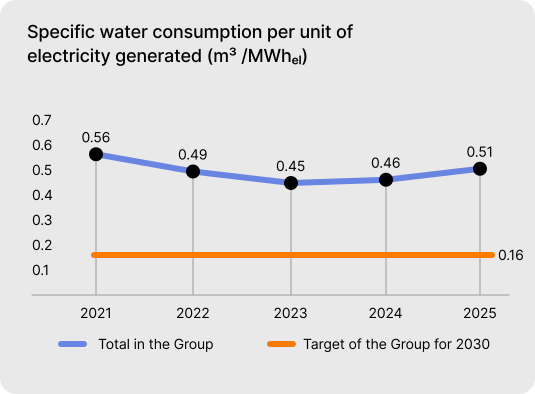
Latvenergo Group commitment to reduce impacts on water resources
 -65%
Reduce water consumption by 2030*
Performance indicator: -65% per unit of energy generated in 2030
*compared to 2022
The Latvenergo Group promotes responsible use of resources and the introduction of circular economy principles throughout the value chain. Special attention is paid to reducing the amount of waste and responsible waste management, assessing the possibilities of reuse, recovery and recycling. The Group implements solutions and uses technologies that help prevent waste at the stage of its generation, while improving processes and optimising resource and energy consumption. This reduces waste generation, promotes material reuse and recycling, and enables more efficient resource circulation.
When developing renewable energy projects, the Latvenergo Group evaluates the durability, repairability and circularity of equipment and materials, promoting their reuse and recycling at the end of their service life.
Latvenergo Group commitment to reduce resource consumption and promote a circular economy
 ≥ 90%
Develop RES technologies while promoting the circular economy
Performance indicator: ≥ 90% recyclable materials in wind turbines in 2026

Latvenergo Group takes care of biodiversity conservation by assessing the impact of existing and planned activities on biodiversity and by implementing statutory and voluntary measures to reduce the impact on specially protected nature areas, species and habitats.
Overhead and cable power lines with a length of more than 6,800 km and an area of 4.9 thousand ha are located in specially protected nature areas or micro-reserves. Sadales tīkls AS builds and maintains power lines in compliance with the protection and use regulations for specially protected nature areas, ensuring the preservation of natural values and preventing significant negative impact on these areas.
Other Latvenergo Group facilities, as well as the sites of planned activities (WPPs, SPPs, electricity charging stations) that are owned or leased by the Group, or sites where development rights have been acquired by the Group, are located outside areas with high biodiversity value.
To reduce the impact of its operations on biodiversity, the Group, in accordance with regulatory requirements, makes annual payments for the restoration of fish resources in the Daugava River basin. In 2025, approximately 1.5 million salmon, sea trout, pikeperch and vimba fry and 6.3 million lamprey larvae were released into rivers. In addition, the Group implements other projects to improve fish habitats and migration – the placement of artificial fish spawning nests in the Daugava and the cleaning of small rivers in the Daugava basin. In 2025, 450 artificial fish spawning nests were placed in the Daugava and monitored with underwater cameras.
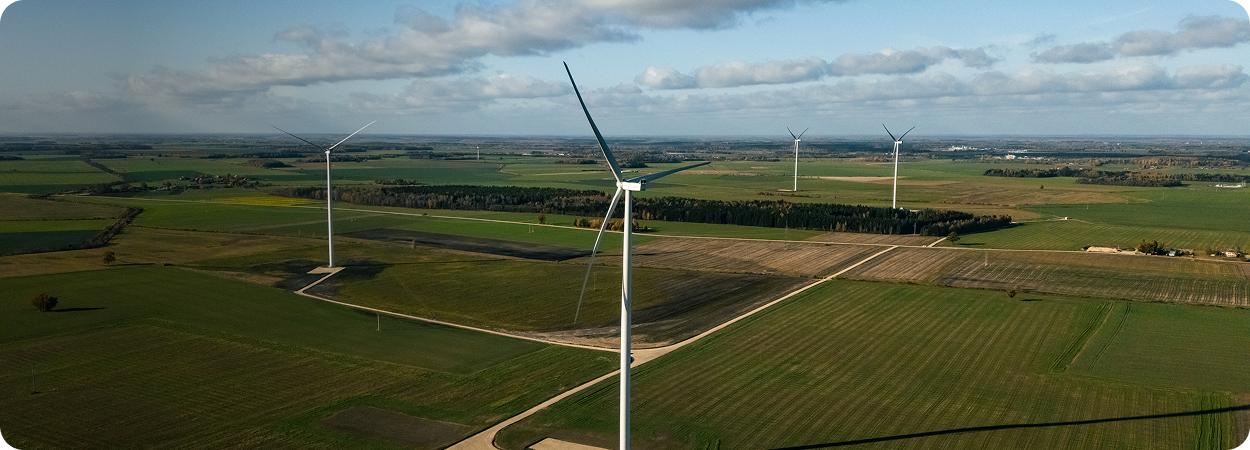
The most significant potential impact of the Group’s investment projects on biodiversity is related to wind farm development. To balance the negative impacts of implementing the planned wind farm projects, activities are planned in close cooperation with nature experts and nature and environmental institutions.
Latvenergo Group commitment to reduce impacts on biodiversity
25 km
Reduce the impact of the HPPs on biodiversity
Performance indicator: 25 km of Daugava basin rivers with improved ecological quality in 2026

Reduce the impact of investment projects on nature
Performance indicator: deforestation in wind farm projects = trees planted
Pursuant to the Water Management Law (2002) and the requirements of Cabinet Regulation No. 736 of 23 December 2003 "Regulations on the Permit for the Use of Water Resources", all Daugava hydropower plants have been issued water resource use permits that set out the conditions for the use of water resources that must be observed when operating the hydropower plants.
CHPP-1 un CHPP-2
The State Environmental Service has issued Category A permits for polluting activities to the thermal power plants of Latvenergo AS.
Permits issued to Latvenergo AS are available in the public data register of the State Environmental Service.
Aiviekste HPP
Pļaviņas HPP
Ķegums HPP
Impact assessments
Active EIA procedures
Site surveys and the preparation of environmental impact assessment (EIA) reports continue in the areas of Latvijas vēja parki SIA, where studies have been carried out on aspects such as wind resources, analysis of specially protected nature areas and restrictions, existing road infrastructure, grid connection availability and the condition of existing networks, as well as field surveys of avifauna, habitats and bats. Biodiversity studies are currently being launched in the wind farm areas of Latvenergo AS in Vāne, Aloja and Piltene. During the EIA procedure, a dialogue is under way with environmental and nature institutions and other organisations, and meetings have been held with the municipalities where the construction of wind farms is planned, so as to take into account, as far as possible, the views of all parties involved. Work is also under way to select the most suitable technological solutions.
Applications have been submitted to the Environmental and Energy Agency and decisions have been taken on the application and initiation of the EIA procedure for seven potential wind farm sites of Latvijas vēja parki SIA, located in the municipalities of Aizkraukle, Limbaži, Valmiera, Ķekava, Ogre, Bauska, Jēkabpils, Līvāni, Augšdaugava, Ventspils and Kuldīga. In these municipalities, initial public consultations on the planned activity have been held and voluntary information seminars/working groups have been organised, attended by experts from various fields, to inform about and explain the most significant impacts of wind parks (physical, landscape, biodiversity) and to answer questions from representatives of local communities and other interested parties. The preparation of the EIA report is currently under way in all projects. For more detailed information on the EIA procedure, we invite you to visit the websites of the Environmental and Energy Agency and Latvijas vēja parki SIA, as well as the Wind energy section of the website.
- Construction of the “Vāne” wind farm and its related infrastructure (Latvenergo AS)
- Implementation of the “Bauska – Ķekava – Ogre” wind farm and its related infrastructure project in Baldone Parish of Ķekava Municipality and Vecumnieki Parish of Bauska Municipality (Latvijas vēja parki SIA)
- Implementation of the “Augšdaugava” wind farm and its related infrastructure project in Rubene, Dunava and Zasa parishes of Jēkabpils Municipality, Jersika Parish of Līvāni Municipality and Dviete Parish of Augšdaugava Municipality (Latvijas vēja parki SIA)
- Implementation of the “Ventspils 2” wind farm and its related infrastructure project in Zira Parish of Ventspils Municipality and Ēdole and Padure parishes of Kuldīga Municipality (Latvijas vēja parki SIA)
- Implementation of the “Ventspils 1” wind farm and its related infrastructure project in Pope, Ugāle, Piltene and Tārgale parishes of Ventspils Municipality (Latvijas vēja parki SIA)
- Implementation of the “Valmiera - Valka” wind farm and its related infrastructure project in Plāņi Parish of Valmiera Municipality and Vijciems and Valka parishes of Valka Municipality (Latvijas vēja parki SIA)
- Implementation of the “Limbaži” wind farm and its related infrastructure project in Salacgrīva and Viļķene parishes of Limbaži Municipality (Latvijas vēja parki SIA)
Construction of the "Laflora" wind farm
Published: 07.09.2021.
Subject of the environmental impact assessment: Construction of the "Laflora" wind farm.
Location of the planned activity (address): Possible site of the "Laflora" wind farm: Līvbērze Parish, Jelgava Municipality, land units (or parts thereof) with cadastre designations 54620060273, 54620040049, 54620040048, 54620040047, 54620040053, 54620040029, 54620040021, 54620040005, 54620040001, 54620040027, 54620040025, 54620040026, 54620040016, 54620040028, 54620040020, 54620040024, 54620040031, 54620040059, 54620040058, 54620040023, 54620040052.
Brief description of the planned activity: The installation of the wind farm is planned in a peat bog area where extraction has been completed or is planned to be completed in the near future. The projected location of the wind turbines would cover both the mineral extraction area and adjoining forest land. The models and technical specifications of the wind turbines to be installed have not yet been determined. At the same time as the installation of the planned wind turbines, it is planned to build anew or, in places, improve the existing infrastructure needed for the installation and operation of wind turbines – access roads, hardstands, energy transmission and telecommunications lines.
Grounds for the decision:
Article 4, paragraph one, points 1) and 4), Article 7, Article 14.¹ paragraphs one, seven and eight of the Law On Environmental Impact Assessment, Annex 1 "Objects for which an impact assessment is required", point 26.¹ sub-points 1) and 2).
Swipe to see more data
| Project initiator | LAFLORA SIA, “Kaigu kūdras purvs”, Līvbērze Parish, Jelgava Municipality, LV – 3014 |
|---|---|
| Application of the initiator of the planned activity | 14.05.2019 |
| Decision on the need for an EIA | 04.06.2019 |
| Programme for the environmental impact assessment | 02.09.2019 |
| EIA opinion issued | 06.09.2021 |
| Initial public consultation | 03.07.2019 at the Līvbērze Culture House hall, Jelgavas iela 17, Līvbērze |
| Public consultation on the EIA report | 11.01.2021 to 15.02.2021 In accordance with Article 20 of the Law on the Management of the Spread of Covid-19 Infection, the public consultation will take place remotely from 14 January to 15 February 2021. The public consultation meeting will take place remotely on 25 January 2020 at 16:00. No later than 22 January 2020, the web link and joining instructions for the meeting will be published: • on the website of Laflora SIA www.laflora.lv; • in the News section of the website of Estonian, Latvian & Lithuanian Environment SIA www.environment.lv. |
- Programme for the environmental impact assessment
- Opinion No. 5-04/10 on the environmental impact assessment report for the construction of the "Laflora" wind farm in Līvbērze Parish, Jelgava Municipality
- Extract from Minutes No. 23 (§ 2) of the meeting of the Jelgava Municipality Council of 27 October 2021 "On the approval of the activity planned by Laflora SIA – construction of the "Laflora" wind farm in Līvbērze Parish, Jelgava Municipality"
04.08.2021. The updated version of the environmental impact assessment report for the wind farm planned by Laflora SIA was submitted to the State Environmental Bureau and its evaluation has begun. Notice on the submission of the updated environmental impact assessment report for the wind farm planned by Laflora SIA to the State Environmental Bureau for an opinion.
28.06.2021. Additional information requested.
28.04.2021. The current version of the environmental impact assessment report for the wind farm planned by Laflora SIA was submitted to the State Environmental Bureau and its evaluation has begun. Notice on the submission of the environmental impact assessment report for the wind farm planned by Laflora SIA to the State Environmental Bureau for an opinion.
Notice on the public consultation on the environmental impact assessment report for the construction of the "Laflora" wind farm in Jelgava Municipality.
Notice on the initial public consultation on the environmental impact assessment report for the construction of the "Laflora" wind farm in Līvbērze Parish, Jelgava Municipality.
- Installation of a water-heating boiler at the Riga Combined Heat and Power Plant CHPP-2
- Reconstruction of existing 110 kV power transmission lines in the section Dundaga - Tume of the power loop “Kurzemes loks”, stage 2
- Reconstruction of the existing power transmission line of Phase 1 of the “Kurzeme Ring” power transmission network connection – Grobiņa substation – Ventspils – Dundaga
Risk management
Industrial accident risks relate to sites where the maximum quantities of hazardous chemicals or hazardous mixtures stored and used exceed the qualifying quantities set out in Cabinet Regulation No. 131 of 1 March 2016 "Procedures for Industrial Accident Risk Assessment and Risk Reduction Measures".
The persons responsible for such high-hazard sites must assess the risk of industrial accidents and develop and implement the necessary industrial accident risk reduction measures to ensure the safety of employees, nearby residents and the public, protect them from the harmful effects of an industrial accident, and preserve a quality environment.
Latvenergo AS classifies the CHPP-1 and CHPP-2 as lower-tier facilities, which are required to develop an industrial accident prevention programme and take other measures to reduce the risk of industrial accidents as provided for by the regulation, as well as to prepare publicly available information material for residents, businesses and organisations in the vicinity of the facility on the actions to be taken in the event of industrial accidents and threats thereof, and on the protective measures provided for in these cases.
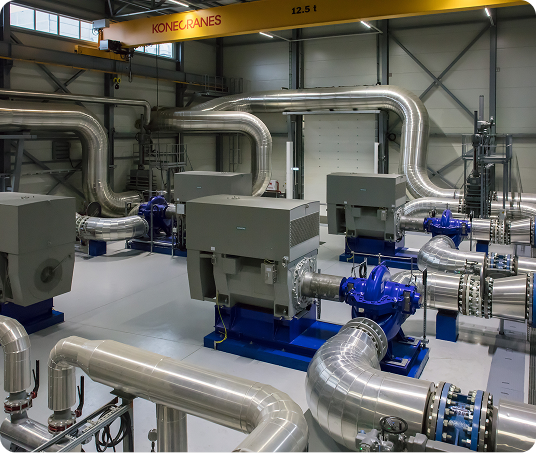
Environmental risk assessment ensures the identification of environmental risks at the facilities operated by Latvenergo Group, risk assessment, classification of risk tier and implementation of risk management measures in accordance with the risk tier, as well as compliance with all requirements of the environmental management standard ISO 14001:2015 regarding the identification of environmental aspects, assessment of their environmental impact and the identification of significant environmental aspects.
One of the main objectives of the environmental management system is the assessment of environmental risks and their effective management. When carrying out a risk and opportunity assessment, an analysis and assessment of the company’s operations and operating environment is carried out to identify inherent risks and opportunities, their likelihood and their significance for the company. Actual and potential adverse impacts are identified, assessed and, where necessary, prioritised.
Environmental risks are identified at all facilities of Latvenergo Group by identifying the environmental risks of risk sources under normal operating conditions, under abnormal conditions, and in emergency situations. The identification of risks takes into account the fact that potential environmental risks may be caused by technical defects in the equipment, violations of operational modes, as well as personnel errors (human factors) or external factors. The preventive measures implemented on-site to reduce the risk are recorded, and their efficiency is evaluated.
Companies are required to implement measures that strengthen their capacity to adapt to climate change, mitigate its adverse impacts, enhance climate resilience while also addressing opportunities related to climate change. To effectively manage climate-related risks, it is essential to identify and assess their potential impacts on operations, assets, supply chains and financial performance in a timely manner, and, where necessary, develop and implement risk-based adaptation and mitigation measures.
Given that climate-related risks can have a significant impact on business continuity, competitiveness and long-term value creation, Latvenergo Group ensures that climate risk assessments are carried out for all assets under its management. The assessments analyse both acute climate risks associated with extreme weather events and chronic climate risks arising from long-term climate change. Risks and opportunities are identified, and their potential impacts on the Group’s operations are evaluated across different time horizons and climate scenarios.
Based on the results of the climate risk assessments, decisions are made regarding the necessary adaptation measures, including their prioritisation, implementation timelines, responsible organisational units and required financial resources. Climate risk assessments are regularly updated to reflect the latest climate science, regulatory requirements and developments in the Group’s operations.
The assessment of chronic climate risks analyses long-term climate change trends, including increases in average air temperature, changes in precipitation patterns, more frequent and prolonged drought periods, changes in hydrological processes, and other climate-related factors that may affect the operation of energy infrastructure, asset lifetime, generation efficiency, cooling and water resource availability, electricity demand and security of supply. Chronic climate risks are assessed using relevant climate scenarios and different time horizons to support the timely planning of adaptation measures and strengthen the Group’s climate resilience.